




Shree Lakshmi Narayan

by Vasudeo Pandya
(inclusive of taxes)

All orders are insured for transit.

This item cannot be shipped outside India.

Details

Year: 1922
Medium: Decorated Oleograph
Size: 22 x 17 inches (framed)
Signature: Bottom Left

Description

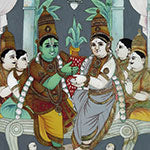
Beautifully decorated oleograph of “Shree Lakshmi Narayan” (Lakshmi and Vishnu) by the artist Vasudeo H. Pandya. The oleograph is signed and dated 1922. Published by Shree
Vasudeo Picture Co, Jarivallas Chall, Arthur Road, Tardeo, Bombay.
Lakshmi is the goddess of wealth, fortune, love, beauty, joy and prosperity. Lakshmi holds a lotus in one hand, and the other hand is shown in abhaya (without fear) and varadamudra (dispensing boons). Vishnu is the sustainer of the universe and occasionally descends to earth assuming various forms (avatars) to redress the balance between good and evil; and is hence known as the preserver. Vishnu is depicted holding in his hands the shankha (conch), the symbol of the five existential elements, the chakra (discus), a symbol of the speed of thought, the padma (lotus) symbol of the power of illusion from which the universe originates and the impulse towards liberation, and the gada (mace), a symbol of knowledge and power. This oleograph has been beautifully decorated by the original owner with sequins. A couple of these have come loose over time within the frame. 

  • ABOUT Vasudeo Pandya

    Vasudeo H. Pandya (1896-1970) was an Indian painter from Gujarat. He initially worked as a document copier in Bombay in a European firm, but became fascinated by the oleograph labels the goods came wrapped in and began to paint emulating their style. He would later travel to Germany and have his works printed as oleographs, as Ravi Varma was doing at the time.

    Read More
  • ABOUT Oleographs

    Oleographs, also called chromolithographs, are multi-colour art prints, stemming from the process of lithography. Pioneered in the 1830s, the process of producing oleographs came into wide commercial use in the 1860s. The technique relied on using several woodblocks or stones with colours for printing, while hand-colouring remained an important aspect as well. Depending on the number of colours present, an oleograph could take months to produce by very skilled workers. Poor preservation and cheaper printing alternatives have made oleographs hard to find. Today, they are mainly used as fine art.

    Read More

You May Also Like