

Satyanarayana

by K.S. Siddalinga Swami
(inclusive of taxes)

All orders are insured for transit.

This item cannot be shipped outside India.

Details

Year: 1929
Medium: Oleograph
Size: 23 x 17 inches (framed)
Signature: Bottom Right

Description

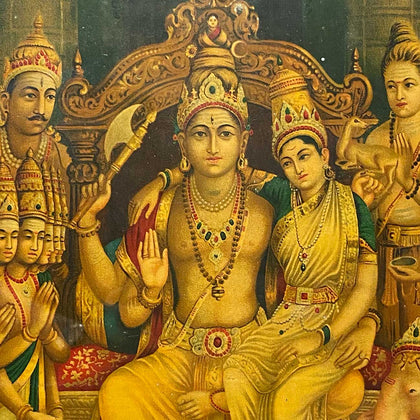
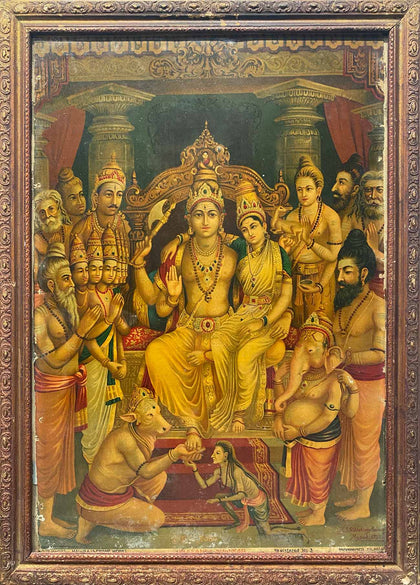
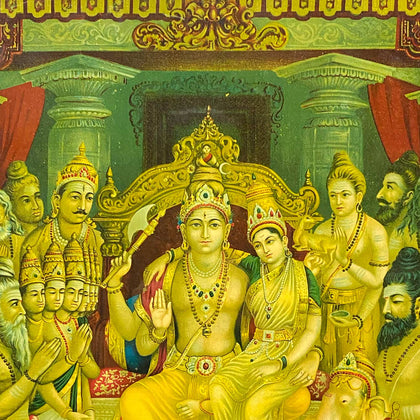
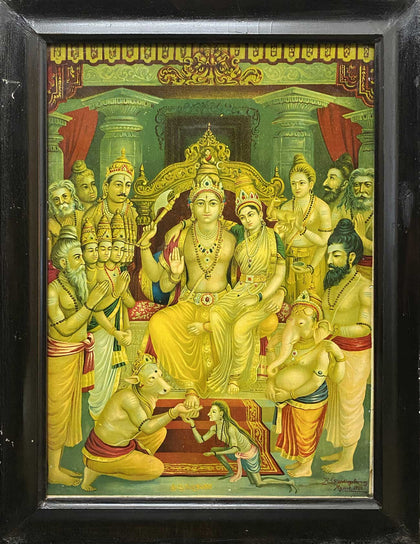
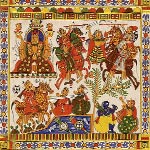
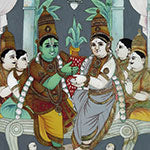
Oleograph of “Satyanarayana” by the artist K.S. Siddalinga Swami of Mysore. The oleograph is signed and dated 1929. It was published by Maharaja Frameworks. 
Satyanarayana is an avatar of the god Vishnu. The name "Satyanarayana" is a combination of "Satya" (truth) and "Narayana" (a name for Vishnu), meaning "the highest being who is the embodiment of truth". Vishnu carries the disc (chakra) - symbol of speed of thought, and the conch (shankha) - symbol of the five existential elements, in his upper hands. In his lower hands, he holds a lotus symbolising purity and transcendence, and the gada (mace), a symbol of knowledge and power. He is being worshipped by devotees, including the sage Devrishi Narada, in a scene that likely represents the Satyanarayana Puja, a ritual performed to seek blessings for prosperity and well-being. Narada was a great devotee of Lord Vishnu and is considered an expert in various arts and sciences, including music and yoga.

  • ABOUT K.S. Siddalinga Swami

    K.S. Siddalinga Swami (1885-1952) worked for the Ravi Varma Press. He was a guru and adviser to the Maharaja of Mysore, as well as renowned sculptor, architect, writer and painter. A number of his paintings are in the Durbar Hall of the Mysore Palace.

    Read More
  • ABOUT Oleographs

    Oleographs, also called chromolithographs, are multi-colour art prints, stemming from the process of lithography. Pioneered in the 1830s, the process of producing oleographs came into wide commercial use in the 1860s. The technique relied on using several woodblocks or stones with colours for printing, while hand-colouring remained an important aspect as well. Depending on the number of colours present, an oleograph could take months to produce by very skilled workers. Poor preservation and cheaper printing alternatives have made oleographs hard to find. Today, they are mainly used as fine art.

    Read More

You May Also Like